Spirits · The Fundamentals · Part 2 of 2
The Art of Distillation: Separating Spirits with Science
How heat, vapor, and a little clever engineering transform fermented liquid into the spirits we know and love.
If you think back to your days in high school or college chemistry, you may remember doing a little something with a bunch of spherical glasses, a bunsen burner, and questionable liquids that your lab teacher told you not to taste. You might have even vaguely remember bringing that liquid to a boil, collecting the vapors, and letting it drip into an empty collection tube. If you did any of that, you performed basic distillation. It is a simplistic process responsible for both purifying water and turning a rather unremarkable fermented liquid into something that can warm your chest, empty your wallet, and inspire an astonishing number of philosophical conversations after midnight.
Distillation has been practiced for centuries by alchemists, physicians, and craftspeople, all fascinated by the idea of capturing the essence of a liquid through heat and vapor - without the extra stuff diluting it.
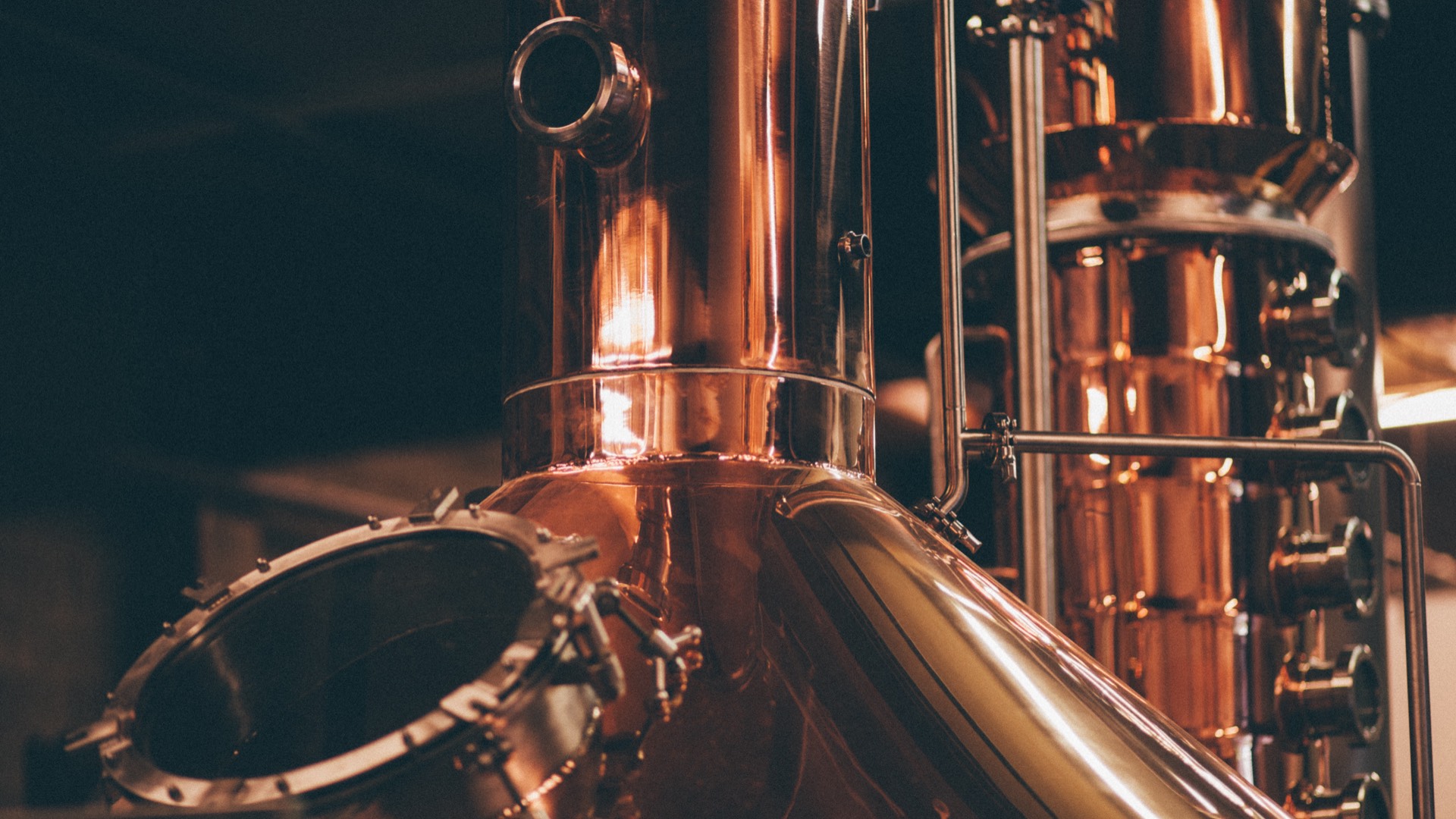
And if you've ever toured a distillery, you've probably seen those magnificent copper contraptions that look like they belong in a Victorian laboratory operated by someone with an unusually ambitious mustache.
But beneath all the polished copper and dramatic clouds of steam lies an elegantly simple scientific principle:
Different substances behave differently when heated, and distillers use those differences to concentrate alcohol and influence flavor.
Of course, there's considerably more to it than putting a pot of fermented liquid over a fire and collecting whatever comes out. The decisions made during distillation can help determine whether a spirit is light and delicate, rich and characterful, intensely aromatic, or almost entirely neutral.
So let's explore what actually happens inside a still, why the equipment matters, and how distillers decide which parts of the resulting liquid deserve to make it into your glass.
And no, before you get excited, we’re not building a moonshine operation in the backyard.
For one thing, that requires more equipment than most people keep beside their cocktail shakers. For another, producing distilled spirits without appropriate authorization is illegal in many jurisdictions, including federally in the United States.
Fortunately, understanding the science doesn't require operating a still yourself.
Distillation, Boiled Up
At its simplest, distillation is a process that separates and concentrates components of a liquid mixture by taking advantage of differences in their volatility.
Volatility describes how readily a substance enters the vapor phase. Some substances are more volatile than others, meaning they tend to evaporate more readily under comparable conditions.
For spirits production, the two substances we're particularly interested in are ethanol - the alcohol we drink - and water. Ethanol is more volatile than water.
But the fermented liquid also contains numerous additional compounds that can influence the finished spirit's flavor and aroma.
In our previous article in this series, we learned that fermentation creates alcohol and a variety of flavor compounds. Distillation takes that fermented mixture and changes its composition.
The distiller heats the liquid, encourages the formation of alcohol-rich vapor, and then cools that vapor until it condenses back into liquid. This collected liquid is known as the distillate.
Depending on the equipment and operating methods, the distillate can contain considerably more alcohol than the original fermented mixture.
Importantly, that distillation doesn't simply separate all the alcohol from everything else. Since different compounds have different volatilities, it gives distillers granular control over which volatile compounds become concentrated in the finished spirit and which are reduced or excluded.
That distinction is what makes distillation an art as well as a science.
The Great Boiling Point Misconception
Now before we venture any further, let's clear up one of the most persistent misconceptions about distillation.
You may have heard something along these lines:
Alcohol boils at 78°C, water boils at 100°C, so distillers simply heat the mixture to 78°C and collect the alcohol while the water stays behind.
It's a wonderfully simple explanation and if the chemistry was accurate, that statement would be true.
There's just one problem: that’s not how a mixture of alcohol and water actually behaves.
Yes, pure ethanol boils at approximately 78.4°C at standard atmospheric pressure, while pure water boils at approximately 100°C. The numbers are correct.
But when ethanol and water are mixed together, they don't behave like two separate liquids politely waiting for their respective turns to evaporate.
Instead, they interact. The mixture has its own boiling behavior, which depends on the relative concentrations of ethanol and water, as well as the surrounding pressure. So when the mixture boils, both ethanol and water contribute to the vapor.
So Why Does Distillation Work?
Given this conundrum, you might ask “if the combined liquid doesn’t have a separate boiling point for each element, how can ethanol be separated from the water?"
Fortunately for us, the laws of chemistry also work such that the vapor above a boiling ethanol-water mixture is generally richer in ethanol than the liquid it's coming from (provided the mixture is within the usual composition range encountered in spirits production). We’ll explain the chemistry behind this in a minute.
For now, let’s break this down a bit: imagine a fermented wash containing roughly 10% alcohol by volume.
When it's heated and vapor begins to form, the vapor can contain a substantially higher proportion of alcohol than the original wash.
Now collect that vapor, cool it back into liquid, and you've produced a more concentrated alcoholic mixture from that vapor.
Suppose you want to further refine the ethanol concentration -> repeat or intensify the separation process (boiling followed by condensation), and you can increase the alcohol concentration further.
This is the fundamental principle behind distillation.
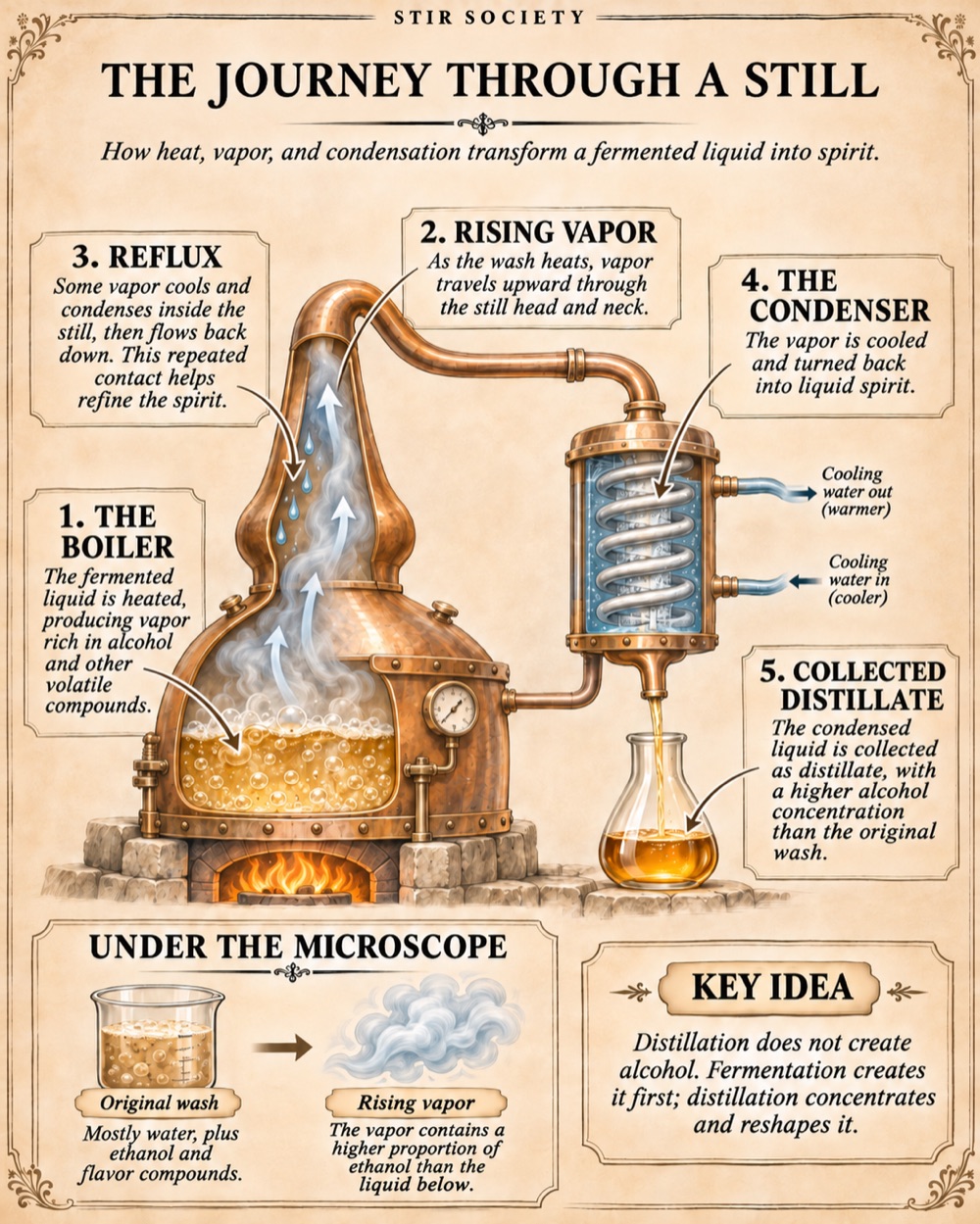
The key isn't that water refuses to evaporate until 100°C. It's that ethanol and water distribute themselves differently between liquid and vapor.
This is called something called the Vapor-Liquid Equilibrium.
Under the Microscope: Vapor–Liquid Equilibrium
Don't worry. This sounds more complicated than it is.
Vapor–liquid equilibrium, often abbreviated as VLE, describes the relationship between a liquid mixture and the vapor in equilibrium with it at a particular temperature and pressure.
For our purposes, the important principle is that the composition of the vapor doesn't necessarily match the composition of the liquid. Ethanol is generally more volatile than water under normal distillation conditions.
Consequently, the vapor formed from a relatively dilute ethanol-water mixture contains a greater proportion of ethanol than the liquid beneath it.
If that vapor is condensed and heated again, the process can increase its ethanol concentration further.
This principle underlies both simple pot distillation and more elaborate fractional distillation systems.
The Ceiling on Ordinary Distillation
Even repeated conventional distillation can't produce completely pure ethanol from a mixture of ethanol and water at ordinary atmospheric pressure.
At a concentration of roughly 95.6% ethanol by mass, the two substances form what chemists call an azeotrope.
In that state, the vapor above the boiling liquid, and the liquid itself have the same chemical composition. That makes further separation through ordinary distillation ineffective.
In practice, distillers can produce highly concentrated neutral spirits through rectification, but the point is, going beyond the ethanol-water azeotrope requires other specialized dehydration techniques.
For most beverage-spirit production, that isn't necessary.
Now if you’ve been paying attention, you might ask yet another question:
Why would a distiller want to remove nearly everything except ethanol and water in the first place? Doesn’t that remove all the esters and flavors that make a spirit unique?
You’re right, and sometimes, that's exactly the goal (think: vodka). Other times, doing so would remove much of what makes the spirit distinctive.
We’ll get into the details of how distillers choose what to keep and what to remove a bit later in this article.
Inside the Still: The Essential Equipment
Now that we understand the basic science, let's look at the equipment that makes it possible.
Although stills can vary enormously in size, complexity, and design, most distillation systems perform three fundamental functions:
They heat a liquid, manage the resulting vapor, and condense selected vapor back into liquid form.
Let's meet the major components.
1. The Boiler: Where the Heat Begins
The boiler contains the liquid being distilled.
Depending on the system, heat may be supplied through steam jackets, internal heating coils, other indirect heating systems, or direct heating. Some equipment can also expose components of the fermented mixture to relatively intense heat, encouraging additional chemical reactions.
The heating method matters because it influences how the liquid is heated and how the process is controlled.
But regardless of the technology, the essential task remains the same: provide energy to generate vapor.
2. The Still Head and Vapor Path
As vapor rises from the boiler, it enters the upper portion of the distillation equipment.
In traditional pot stills, this may involve a domed head, a long curved neck, and a pipe leading toward the condenser. The shape and dimensions of this vapor path can influence the spirit.
How?
Some vapor may cool and condense before reaching the actual condenser. That liquid (called reflux) can then flow back toward the boiler, re-entering the mixture and creating an opportunity for additional separation.
We'll explore this phenomenon shortly.
3. The Condenser: Turning Vapor Back into Liquid
Once vapor has traveled through the still, it needs to cool down. That's the condenser's job.
A condenser transfers heat away from the vapor, allowing it to return to liquid form.
Traditional systems might use a coiled pipe immersed in cooling water, while modern distilleries often use shell-and-tube condensers or other designs.
The resulting liquid is the distillate.
If you've ever wondered why distilleries need cooling water even though they're using heat to make spirits, there's your answer.
4. The Collection System
Finally, the condensed spirit is directed into appropriate collection vessels or receiving systems.
Depending on the distillation method, producers may separate different portions of the output, redirect particular fractions, or continuously manage the composition of the spirit being collected.
This is especially important because the distillate's composition can change throughout a batch run. Not every portion of that run is intended to become the final spirit.
Pot Stills vs. Column Stills: Two Approaches to Distillation
When exploring spirits production, you'll repeatedly encounter two major types of equipment.
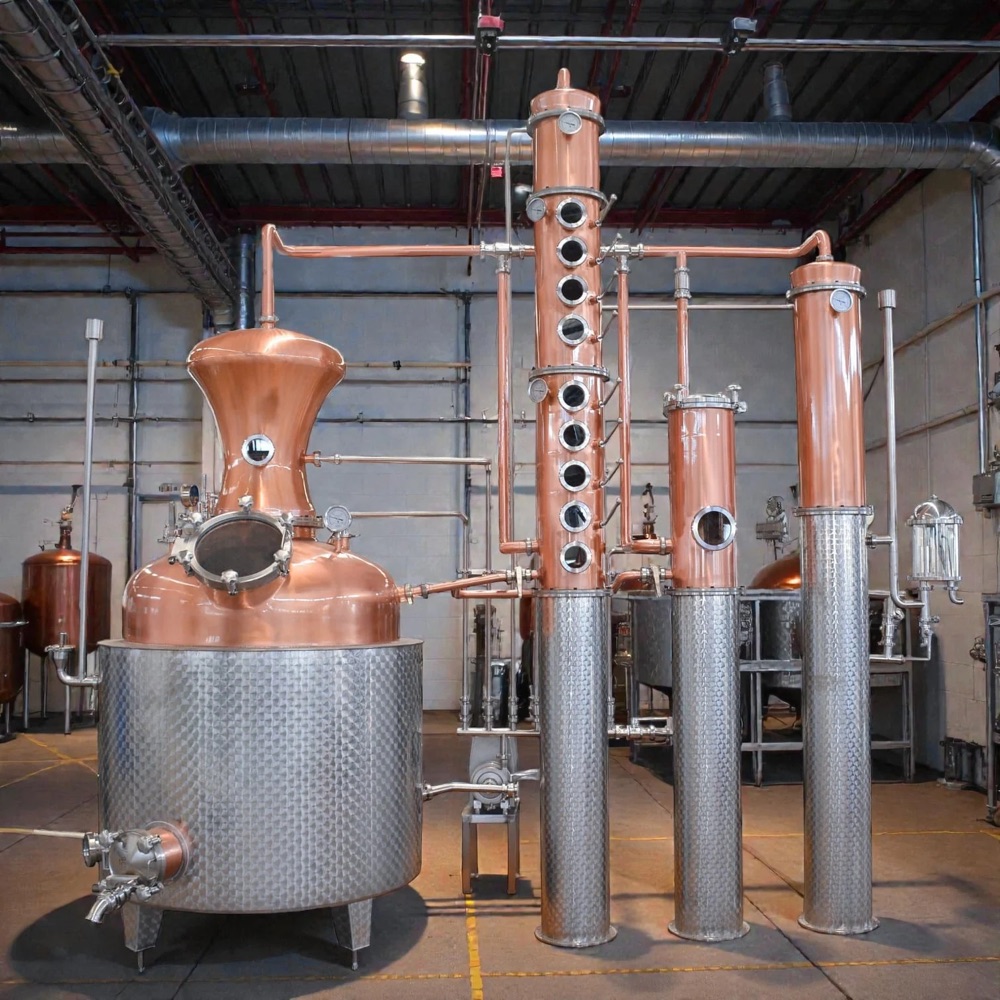
Pot stills and column stills.
They operate on the same fundamental scientific principles, but their designs allow distillers to manage separation in different ways.
We'll devote our next article in “Fundamentals” to them in detail, so consider this a first introduction.
Pot Stills: The Traditional Approach
Pot stills are commonly associated with batch distillation. A fermented liquid is loaded into the still, heated, and distilled. Once the run is complete, the equipment is prepared for another batch.
Traditional pot stills are especially familiar in the production of Scotch malt whisky, Cognac, and certain styles of rum and mezcal.
Because pot still distillation often involves relatively limited separation compared with highly rectifying column systems, it can preserve substantial amounts of flavor compounds. This helps explain why certain pot-distilled spirits are particularly rich and characterful.
But don't assume every pot still produces a heavy spirit.
Still shape, distillation strength, reflux, copper contact, and the distiller's decisions all influence the result.
Column Stills: Continuous Separation
Column stills use much taller structures containing plates, packing, or other internal components that encourage repeated vapor-liquid contact.
Depending on their configuration, they can achieve substantial separation within one integrated system.
Many operate continuously, allowing fermented liquid to enter while different streams are removed.
Column stills are widely used in vodka, grain whiskey, rum, and numerous other spirit categories.
They're particularly useful when producers want precise control over alcohol concentration and the balance of compounds retained.
But here's another misconception worth correcting:
Column-distilled spirits aren't necessarily neutral or flavorless.
A column still can be operated to produce an intensely characterful distillate, just as a pot still can be used in multiple runs to achieve a relatively high level of refinement.
| Feature | Pot stills | Column stills |
|---|---|---|
| Typical operation | Batch | Often continuous, though some operate in batches |
| Separation | Often fewer effective separation stages per run | Can provide extensive repeated separation |
| Common applications | Malt whisky, Cognac, characterful rum | Vodka, grain whiskey, rum, and many others |
| Flavor potential | Often retains substantial congeners | Can produce neutral or characterful spirits |
| Production flexibility | Individual batch decisions | Flexible control through column design and operating conditions |
We'll explore the mechanics, advantages, and limitations of each system in our next article.
Heads, Hearts & Tails: The Art of Making the Cut
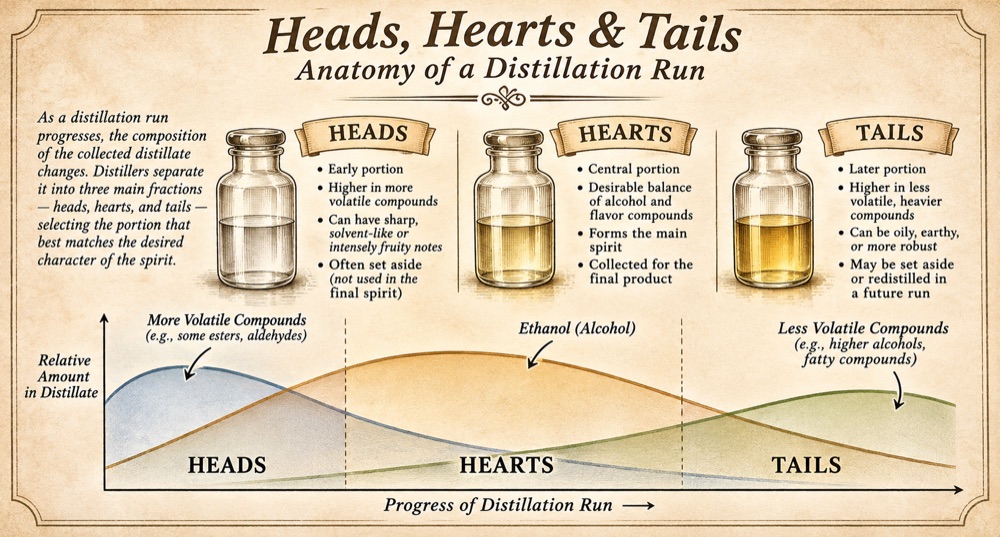
When a distiller operates a batch still, the liquid collected at the beginning of the run doesn't have exactly the same composition as the liquid collected toward the end - which probably makes sense. Different compounds move through the system in different proportions as conditions change.
Distillers commonly describe three broad portions of a batch distillation run:
Heads, hearts, and tails.
These names refer to fractions of the distillate, and deciding where to separate them is one of the most consequential choices in producing a spirit.
Heads: The Early Arrivals
The heads are the earlier portion of the distillation run.
They often contain higher relative concentrations of certain highly volatile compounds, which can produce sharp, solvent-like, or intensely fruity aromas.
Some of these compounds can be desirable in carefully controlled amounts. Others may contribute unwanted characteristics.
The very earliest portion is sometimes distinguished as the foreshots, depending on the production tradition.
But distillation fractions don't have perfectly defined chemical boundaries. They overlap, and their composition depends on the fermented liquid, still design, and operating conditions.
Hearts: The Main Event
The hearts are the central portion of the run, commonly selected to form the principal spirit.
They contain ethanol, water, and a combination of other volatile compounds. The exact composition varies according to the spirit being produced.
A distiller making a highly characterful whiskey may seek a different balance than one producing a relatively light grape brandy.
So while the hearts are often described as the desirable middle portion, the goal isn't necessarily to collect only ethanol and water.
It's to collect the combination of alcohol and flavor compounds that produces the intended spirit.
This is where the judgment of an experienced distiller becomes particularly important.
Tails: The Late Arrivals
As a batch distillation run progresses, the alcohol concentration of the liquid remaining in the boiler generally falls and the composition of the collected distillate changes accordingly.
The later portion, known as the tails, may contain higher relative concentrations of certain heavier or less volatile compounds.
These can contribute oily, earthy, cereal-like, or other distinctive characteristics. Some may be undesirable in excess, while others can add complexity.
Distillers therefore decide how much of the later-run character they want in the finished spirit.
Certain fractions may also be recovered and included in subsequent distillation runs, depending on the production process.
What About Methanol?
You may have heard that the first liquid collected from a still is pure methanol, and that simply discarding it makes the remaining spirit safe.
That's a dangerous oversimplification.
Methanol can arise naturally during the processing and fermentation of some raw materials, particularly fruits containing pectin. Its distribution during distillation is more complicated than a simple first-in, first-out sequence.
It cannot reliably be eliminated merely by discarding a fixed volume of early distillate.
Methanol is a dangerous compound that can cause blindness and lead to nerve damage, breathing difficulties, and even death. Commercial spirits producers rely on appropriate raw materials, validated production controls, applicable standards, and analytical testing - not folklore about the first few drops.
We’ve been through the methanol horror adventure before, during Prohibition with illicit moonshine production. Many of the distillates marketed by those cloak-and-dagger producers were contaminated with methanol, leading to many alcohol-related deaths.
This is another reason distillation belongs in properly equipped, regulated production facilities rather than improvised home experiments.
Under the Microscope: Reflux, Rectification & Flavor
So exactly how can distillers control the composition of the final ethanol in the collection apparatus? We've touched on these concepts before, so let's explore them more now.
What Is Reflux?
We've mentioned reflux a few times already.
Reflux occurs when vapor condenses within the still and some of that liquid returns toward an earlier part of the distillation system.
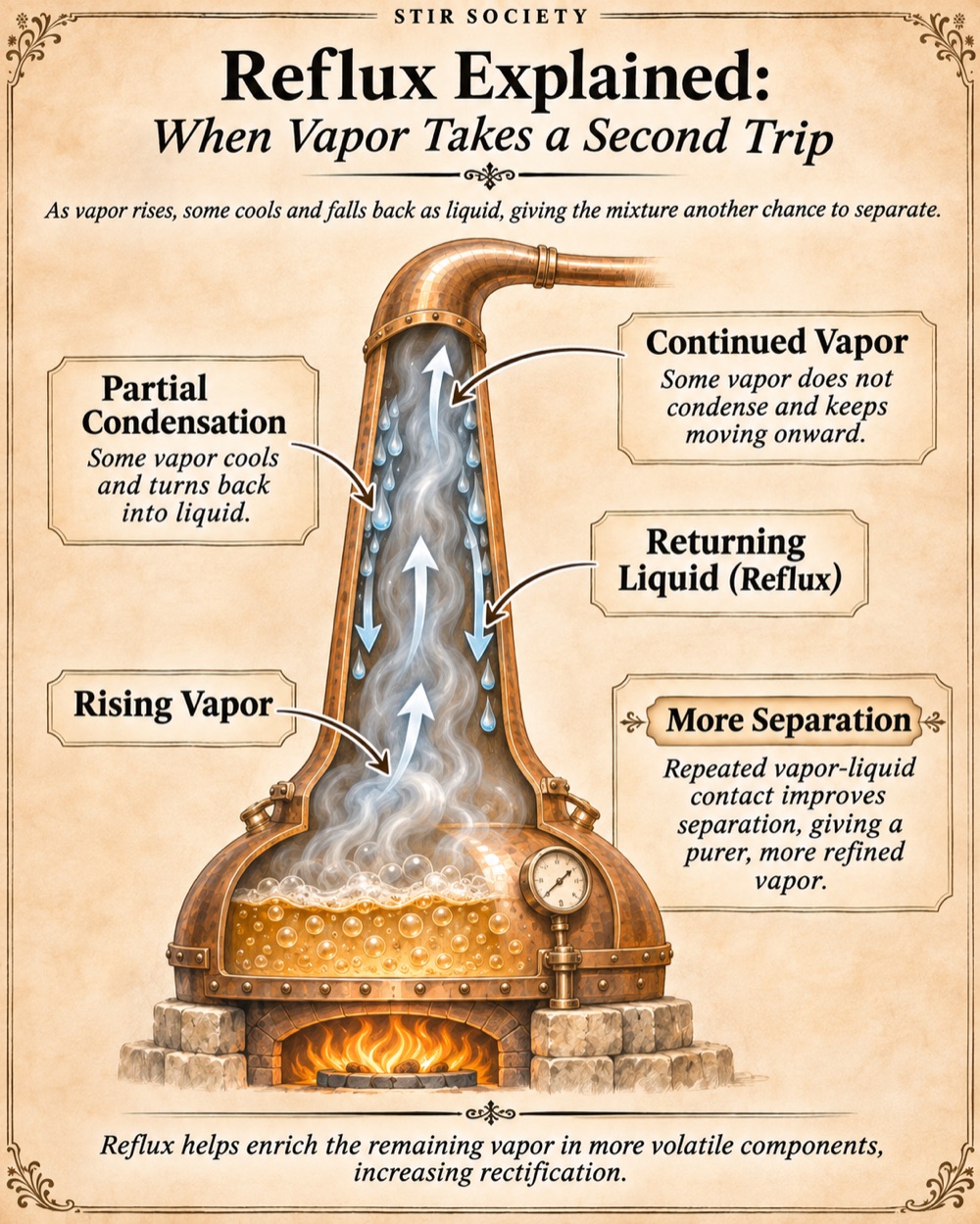
As the returning liquid encounters rising vapor, additional exchange and separation can occur. This can make the vapor continuing through the equipment richer in more volatile components.
In simple terms, reflux gives the mixture additional opportunities to separate. The amount of reflux depends on the equipment and how it's operated. In pot stills, some reflux can occur naturally in the neck and vapor path. In column stills, reflux can be actively managed to achieve extensive separation.
What Is Rectification?
Rectification refers to increasing the concentration and separation of components through repeated vapor-liquid contact.
A highly rectified spirit generally contains a high proportion of ethanol relative to many other volatile components.
This is especially relevant to vodka and neutral spirits.
But here's the tradeoff: the more extensively a spirit is rectified, the more certain flavor compounds may be reduced or removed.
For vodka, a clean, restrained profile may be exactly the objective. For rum or whiskey, preserving selected congeners may be essential.
The art lies in choosing the right balance.
Does Copper Actually Matter?
If you've ever toured a whiskey or brandy distillery, you'll probably have noticed how frequently copper appears.
While copper certainly looks beautiful when polished, its role isn't purely decorative.
Copper can participate in reactions that reduce certain unwanted sulfur-containing compounds during distillation. Those compounds can otherwise produce unpleasant aromas associated with rubber, cooked vegetables, or other sulfurous notes.
The amount and location of copper contact, along with the still's operating conditions, can influence the result.
However, copper isn't a magic filter that automatically removes everything undesirable. Nor does this mean that stainless steel is inherently unsuitable for producing high-quality spirits.
Many distillation systems use combinations of materials to achieve specific results.
The important lesson is that the material of the still can affect the chemistry of the distillation process, not merely its appearance.
Across the Spirits: What Distillation Means for Each Family
So, we’ve now encountered quite a few technical concepts. Let's connect them to the spirits you might have already read about.
| Spirit | How distillation commonly shapes its character |
|---|---|
| Whiskey | Pot, column, or hybrid systems concentrate alcohol while retaining selected grain- and fermentation-derived compounds |
| Gin | Neutral alcohol is often redistilled with botanicals, allowing their volatile aromatic compounds to become part of the spirit |
| Vodka | Extensive rectification is commonly used to create a relatively clean, neutral profile |
| Tequila & Mezcal | Various still designs and production traditions influence how cooked agave and fermentation character carry into the finished spirit |
| Rum | Pot, column, and blended distillates offer a remarkable range, from light and delicate to intensely aromatic |
| Brandy | Distillation choices help preserve and shape fruit-derived aromas, with important differences between Cognac, Armagnac, pisco, and other styles |
Notice something?
Every spirit relies on the same underlying physical principles. Yet the objectives can be dramatically different.
- The distiller producing vodka might seek a spirit with very little residual aroma.
- A Jamaican rum producer may want to retain an assertive collection of fruity compounds.
- A Cognac producer seeks a distillate with the character and balance needed for extended oak maturation.
- And gin producers often begin with an already refined alcohol before using another distillation to introduce botanical aromas.
Behind the Bar: Put It to the Test
All right, enough vapor-liquid equilibrium and complicated copper equipment.
Let's translate this knowledge into something we can appreciate with a cocktail glass.
Unfortunately, we can't isolate distillation as a single variable simply by comparing two bottles from the liquor store: their raw materials, fermentation methods, maturation, and blending may also differ.
But we can conduct an interesting guided tasting that highlights some of the sensory differences associated with varying degrees of spirit character.
Experiment: The Spirit Character Comparison
For this exercise, we'll compare three unaged or relatively lightly matured spirits with deliberately different sensory profiles.
Choose:
- A standard unflavored vodka
- A relatively light white rum
- A characterful unaged rum, such as a Jamaican white overproof expression
Ideally, keep serving temperatures consistent. Because these spirits may differ substantially in alcohol strength, use very small pours and compare cautiously. Higher-proof samples can be diluted with water for a more comfortable tasting experience.
Step 1: Compare the Aromas
Begin by smelling each spirit gently.
The vodka may seem relatively restrained, with fewer pronounced aromas beyond the alcohol itself. The lighter rum may reveal subtle sugarcane-derived or fermentation-related notes. The more characterful rum may offer intense fruit aromas, fermented notes, or other distinctive characteristics.
Try identifying which spirit has the greatest aromatic intensity.
Step 2: Compare the Mouthfeel
Take a very small sip of each. Notice the texture and overall flavor impression. Does one seem light and crisp? Does another feel more aromatic? Does the alcohol seem particularly prominent in one sample?
Remember that bottling strength and temperature can strongly influence these perceptions.
Step 3: Ask What the Distiller Wanted
This is the most important part of the experiment. Instead of asking which spirit is objectively better, consider the likely production objective.
The vodka producer may have intended to create a relatively neutral spirit while the lighter rum producer may have sought a clean, balanced style suitable for refreshing cocktails.
If you look up the brands and distilleries for what you’re tasting, sometimes their websites contain information about how their expressions are distilled, which can give you an idea on what they were aiming for.
Apply the Lesson to Cocktails
Now think about how each spirit might behave in a drink.
A neutral vodka allows other ingredients to dominate. A light rum contributes its own character without necessarily overpowering citrus or sweetness. An intensely aromatic rum may dramatically reshape a cocktail, even when used in a relatively small amount.
What This Experiment Doesn't Prove
A final reminder: tasting different commercially produced spirits doesn't allow us to isolate distillation from fermentation, raw materials, aging, and other production choices.
We're learning to recognize sensory contrasts and connect them to possible production objectives.
That’s considerably more enjoyable than calculating vapor-pressure curves over a glass of warm water.
Some Final Thoughts on Distillation
If fermentation is the stage where alcohol and many flavor compounds are created, distillation is where producers begin deciding which of those components will help define the finished spirit.
By controlling how vapor forms, travels, condenses, and separates, distillers can influence both alcohol concentration and flavor. The type of still, the amount of reflux, the separation of different fractions, and the interaction with materials such as copper can all shape the result.
That's what makes distillation so fascinating.
It's a science governed by physical and chemical principles, but it also demands craftsmanship, experience, and a clear vision of what the spirit is supposed to become.
For the bartender, understanding distillation provides an entirely new way to appreciate the bottles on your shelf. Instead of seeing whiskey, vodka, rum, or brandy simply as different ingredients, you can begin thinking about how each spirit's character was shaped.
Why one rum is light and another bursts with tropical fruit. Why vodka is comparatively restrained. Why two brandies made from grapes can develop such different personalities.
The answers often begin long before the spirit enters a barrel or reaches a cocktail shaker.
They begin in the still.
Up next in Masterclass: Pot Stills vs. Column Stills — Two Paths to the Same Spirit.