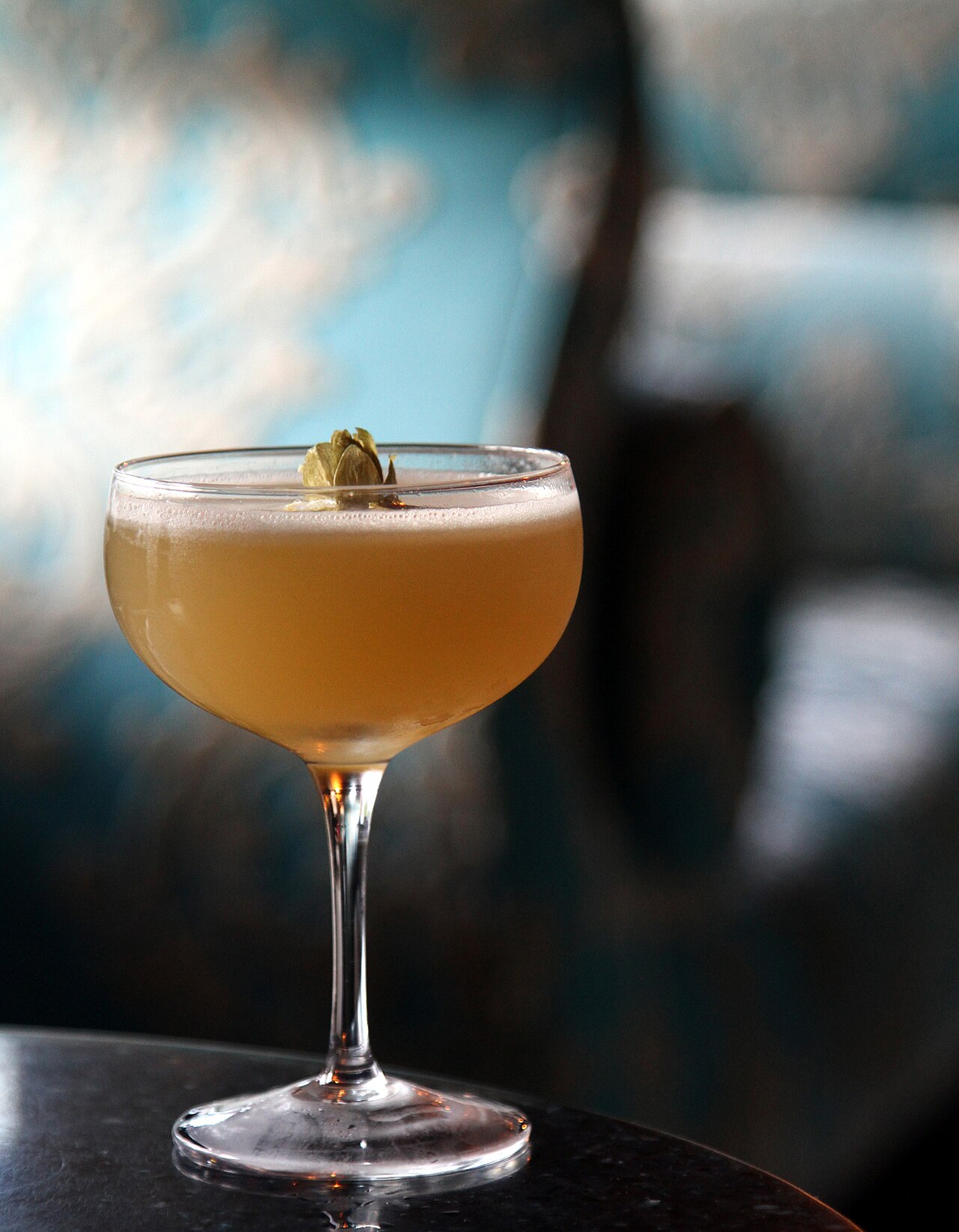
Derivative · Gin
Gimlet
Gin and lime, historically with Rose's lime cordial; modern versions use fresh lime and syrup.
Ingredients
- 2 ozLondon dry gin
- ¾ ozFresh lime juice
- ¾ ozSimple syrup
Method
- Shake all ingredients with ice.
- Strain into a chilled coupe.
History
The history of the gimlet is one of the more fascinating ones in the cocktail world. To understand it, we need to delve a little bit into medical history and talk about scurvy. Scurvy was a familiar and often devastating threat on long sea voyages, when crews spent months without fresh food. It could disable or kill large numbers of sailors, weakening ships through illness as well as death. Before its cause was understood, sailors developed fatigue and weakness, swollen and bleeding gums, loose teeth, easy bruising, painful joints, and wounds that reopened or healed poorly. In severe cases, bleeding, infection, and profound debility could prove fatal.
The French explorer Jacques Cartier’s 1535–36 expedition offers a notable early account: scurvy struck his crew during the winter near what is now Quebec. Indigenous people in the region showed the sailors how to prepare a remedy from a local evergreen, commonly identified as arbor vitae. Centuries later, Commodore George Anson’s 1740–44 voyage became another stark illustration of the disease’s toll: scurvy ravaged his crews during the circumnavigation, although lack of food, combat, and other illnesses also contributed to the expedition’s losses.
Some sailors and physicians had already noticed that citrus could help. In 1601, English naval commander James Lancaster tested lemon juice on a voyage to the East Indies, and surgeon John Woodall later recommended citrus in sailors’ provisions. By the 17th century, English sailors had recognized that citrus fruit helped prevent scurvy, but the knowledge was not consistently adopted.
In 1747, Scottish surgeon James Lind conducted clinical experiments comparing treatments among a small group of sailors with scurvy and found that the two given oranges and lemons recovered fastest. His 1753 book publicized the result, though he did not identify vitamin C as the cause; he also believe scurvy occurred due to poorly digested and putrefying food, bad water, overwork, and damp living conditions. As a result, he did not advocate citrus as a stand-alone remedy.
In 1794, Rear Admiral Alan Gardner insisted that lemon juice be issued daily aboard the Suffolk during its 23-week nonstop voyage to India. There was no serious outbreak of scurvy. The voyage, together with Lind’s earlier findings, convinced the Navy to recommend lemon juice be issued routinely across the fleet. Naval physician Gilbert Blane helped secure its regular issue in 1795; but it was only in the 1930s when researchers formally established that scurvy results from vitamin C deficiency.
As the benefits of citrus juice became more widely known, British sailors drank large quantities of it, especially lime juice. They often mixed it with their daily ration of rum and water (‘grog’), earning them the affectionate nickname ‘Limeys’. The 1867 Merchant Shipping Act made it mandatory for all British ships to carry lime juice rations for their crews, preserved with 15% rum. In 1867, Lauchlin Rose, a shipyard owner in Leith, Scotland, patented a process for preserving fruit juice with sugar instead of alcohol. To make his product more appealing, he packaged it in an attractive bottle and named it ‘Rose’s Lime Cordial’.
Legend has it that the rank-and-file sailors drank rum while their officers drank gin, so the officers mixed Rose’s lime cordial with gin to make the drink. As for the name, a 'gimlet' was a small tool used to tap the barrels of spirits carried on British Navy ships. As all legends go, these origins are murky at best, but it does explain how the cocktail arose from circumstance rather than clever mixing. Keep in mind, sailors had no ice and so likely drank an unchilled, rather tepid, gimlet (essentially a room temperature 50–50 Gimlet). However, when stirred over ice and mixed in more balanced proportions, the result is exceptionally refreshing.
Flavour
Details
- Glass
- Coupe
- Garnish
- Lime wheel
- Technique
- shaken
Family
Derived from
Gin Sour - lemon -> limeCompared with Gin Sour
What changes: lemon -> lime.
Gin Sour
- 2 ozLondon dry gin
- 1 ozlemon juice
- ½ ozsimple syrup
- ½ ozegg white (optional)
- 3 dashesAngostura bitters (optional)
Gimlet
- 2 ozLondon dry gin
- ¾ ozFresh lime juice
- ¾ ozSimple syrup
Green = new ingredient · Gold = different amount · Red = not used in Gimlet